This 5LetterWords.io review replaces my earlier look at the site because the product and its word sets have changed. The current finder reports 13,645 five-letter words, while the Wordle solver uses a separate 9,476-answer NYT Crossplay set. The interface also distinguishes strict possible answers from broader next-guess suggestions, which is a meaningful change from a generic word filter.
I re-tested the live site on July 21, 2026. I did not rely on the old screenshots or counts. The test cases were designed to expose four different behaviors: letter-rack filtering, exact anagrams, positional Wordle clues, and Wordle’s awkward repeated-letter rule. I also checked dictionary scope and Scrabble-style scores against the product’s current methodology page.
The short verdict is that 5LetterWords.io is fast, unusually transparent about its data sets, and good at keeping several puzzle models separate. Its biggest limitation is also a consequence of that breadth: the all-dictionaries finder includes uncommon valid words, and the heuristic next guess can be broader than the official-looking answer list.
The four tests at a glance
| Test | Input | Expected behavior | Live result on July 21, 2026 |
|---|---|---|---|
| Finder letter rack | ATPLE in “Use only letters” | Five-letter words formed only from those letters | 8 results, all score 7 |
| Exact anagram | ELTAP | Use every letter once | Same 8 exact anagrams |
| Wordle pattern | green CR_NE, gray OSTL | Respect exact positions and exclusions | 1 possible answer: CRANE |
| Duplicate rule | feedback from ALLEY against APPLE | Keep one confirmed L despite another gray L | 19 candidates remained, including APPLE |
Those results are reproducible observations, not a claim that every word in every dictionary is appropriate for every game.
Test 1: ATPLE returned eight precise finder results
The homepage places the result preview beside the full filter panel. I entered ATPLE into Use only letters. The finder returned exactly eight words:
LEAPT, LEPTA, PALET, PELTA, PETAL, PLATE, PLEAT, and TEPAL.
Each displayed a Scrabble-style score of 7. The count and set made sense: each result uses five letters drawn from the supplied rack and none introduces a letter outside A, T, P, L, and E.
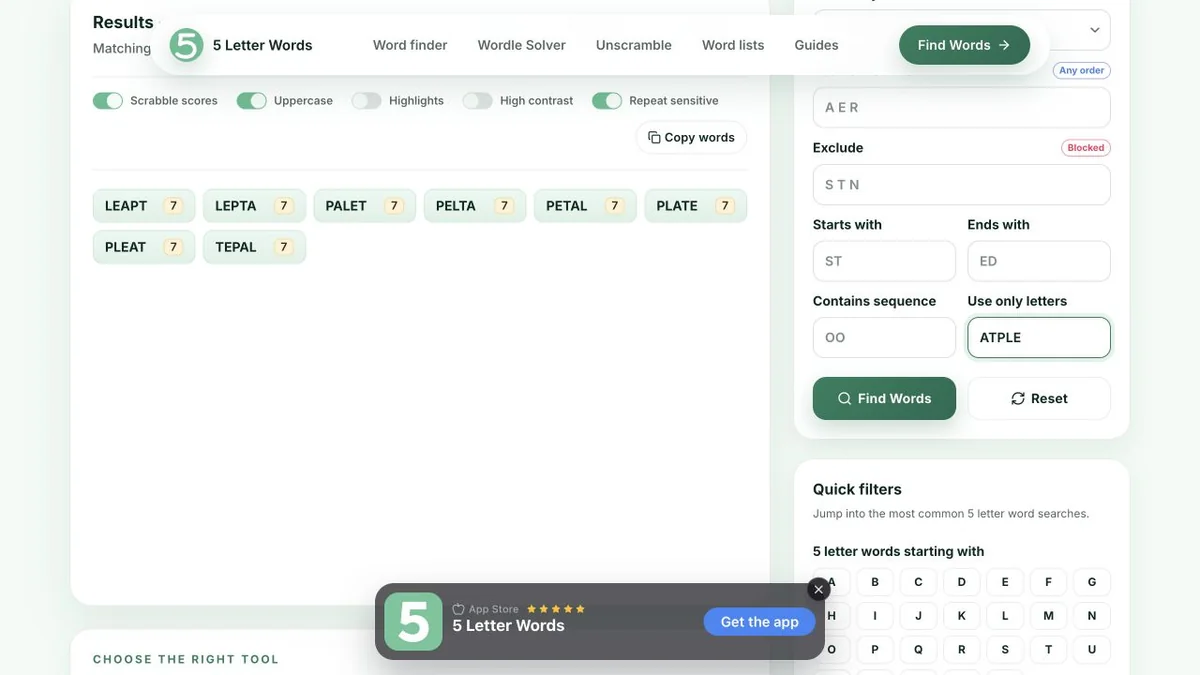
Hands-on finder test on July 21, 2026: ATPLE produced eight five-letter results, each with a displayed score of 7.
The finder supports more than a rack. It can combine exact-position patterns, required letters, excluded letters, starts-with, ends-with, and contains-sequence filters. The result view can switch sorting and toggle uppercase, scores, highlights, contrast, and repeat-sensitive behavior.
The repeat-sensitive toggle is easy to underestimate. A rack with two copies of a letter is different from a rack with one. A solver that treats letters as a set rather than a counted collection will return impossible plays. The site exposes that behavior rather than hiding it in a footnote.
I also like that the result tiles remain scannable with scoring enabled. They show enough information for a quick comparison without turning the word list into a statistics dashboard.
Test 2: ELTAP produced the same eight exact anagrams
The Unscramble tool frames the task differently. A five-letter input is treated as an exact anagram request: every supplied letter must be used once. A longer rack can instead produce five-letter words built from a subset.
I entered ELTAP. The exact-anagram section returned the same eight-word set as the ATPLE rack test: LEAPT, LEPTA, PALET, PELTA, PETAL, PLATE, PLEAT, and TEPAL.
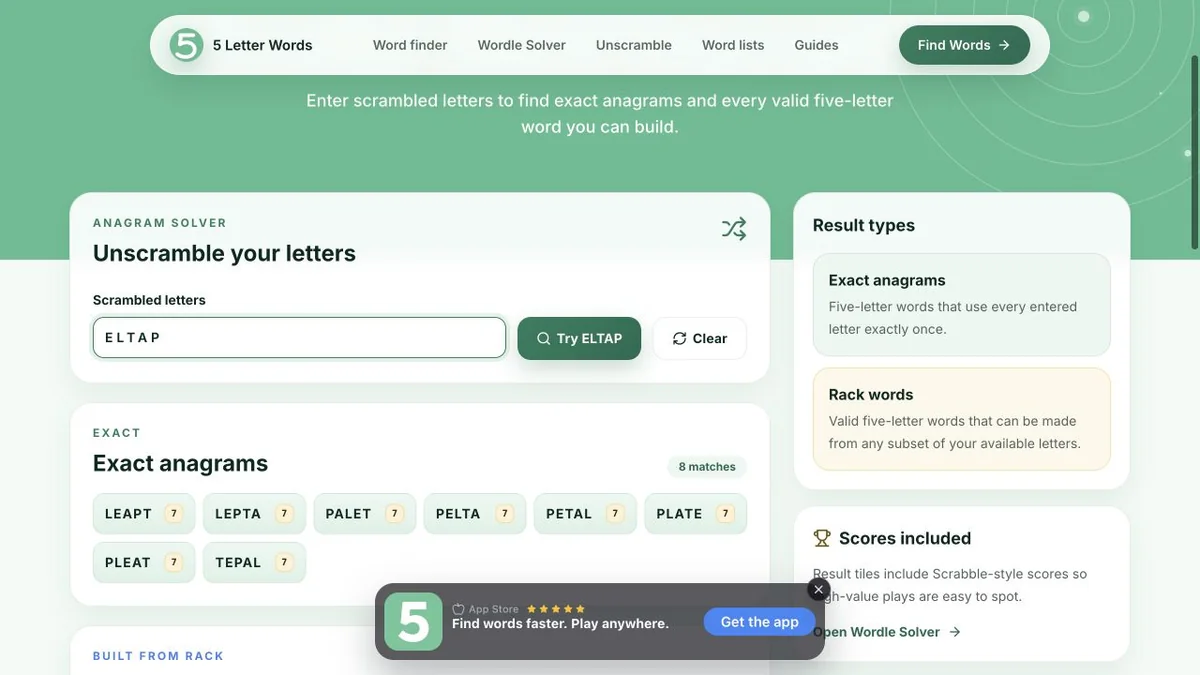
Hands-on anagram test on July 21, 2026: all eight results used E, L, T, A, and P exactly once.
This agreement is a useful cross-check. ATPLE and ELTAP are the same multiset of letters, so the exact five-letter result sets should match regardless of order. They did.
The page also explains the difference between exact anagrams and rack words. That prevents a common source of confusion: a person entering seven Scrabble tiles may want any playable five-letter subset, while a jumble solver expects every supplied letter to appear.
Scores are helpful but not game authority. A displayed Scrabble-style total does not prove the word is legal in a particular regional tournament dictionary, and Words With Friends assigns values differently. That is why the dictionary filter matters.
Test 3: CR_NE plus OSTL narrowed to CRANE
The current Wordle Solver uses five separate green slots, five position-specific yellow fields, and one gray-letter field. This matches the feedback model more closely than a single pattern box.
For the positional test I entered:
- green
Cin position 1; - green
Rin position 2; - green
Nin position 4; - green
Ein position 5; and - gray letters
O,S,T, andL.
That represents CR_NE with OSTL excluded. The solver showed 1 left and returned CRANE.
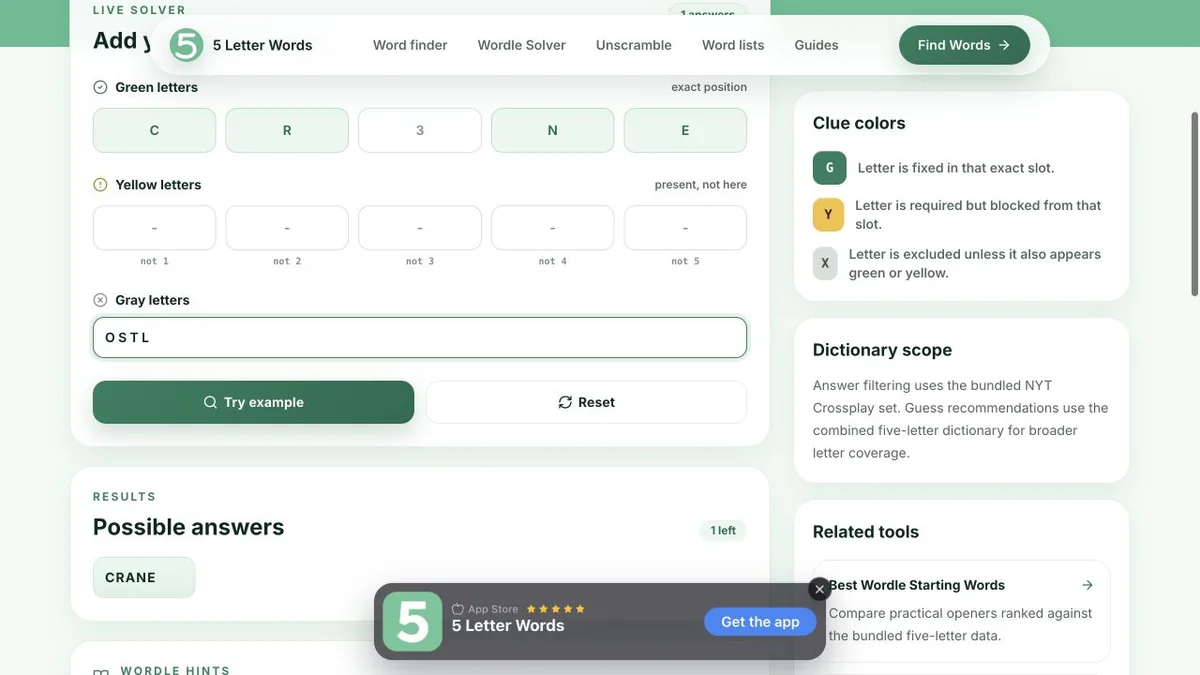
Hands-on Wordle test on July 21, 2026: exact green positions plus OSTL exclusions left CRANE as the only answer.
The important detail is that the solver is not searching the full 13,645-word finder set for this panel. It reports 9,476 answers from the bundled NYT Crossplay set. That keeps answer filtering tied to the product’s stated Wordle source while allowing the general finder to serve Scrabble and broader word-list use.
The interface separates Possible answers from Best next guesses. Possible answers obey the clues strictly. Next guesses are heuristic probes drawn from the broader five-letter dictionary to test useful letters. A suggested next guess can therefore be valuable without being a possible answer, and it can also be too obscure for a player’s taste.
In the one-answer CRANE case, the strict result is the actionable information. A player who wants only a hint rather than the final word should stop earlier, with fewer clues entered.
Test 4: duplicate feedback kept APPLE alive
Repeated letters are where many Wordle helpers fail. Consider guessing ALLEY when the answer is APPLE:
Ain position 1 is green;- the first
L, in position 2, is yellow because the answer’sLis elsewhere; - the second
L, in position 3, is gray because the answer contains only oneL; Ein position 4 is yellow; andYis gray.
A naive gray-letter rule would eliminate every word containing L, contradicting the confirmed yellow L. I entered green A in slot 1, yellow L blocked from slot 2, yellow E blocked from slot 4, and gray LY.
The solver left 19 possible answers, and APPLE remained in the set. That demonstrates the intended rule: a gray copy does not erase the same letter when another copy has already been confirmed green or yellow. The gray feedback can still constrain the number of copies.
The candidate list also included uncommon words because it belongs to the stated Wordle answer data, not a subjective “words I recognize” list. The heuristic panel suggested ANCLE as a next guess in this state. That suggestion illustrates the tool’s two-list design well: it was presented as a letter-coverage heuristic, not as one of the 19 strict possible answers.
I would like a “common guesses only” option for that panel. Broad vocabulary can maximize information mathematically while feeling unhelpful to a person who wants a plausible everyday guess.
Where 13,645 and 9,476 come from
The site’s Sources & Methodology page is one of its best features. It names the collections and distinguishes their purposes instead of presenting one unexplained “dictionary.”
The All Dictionaries finder count is currently 13,645 five-letter words. The site combines normalized sources, removes invalid lengths and non-letter forms, and provides dictionary-specific filters. The available scope includes general entries plus Scrabble US, Scrabble UK, and Words With Friends views.
The Wordle NYT Crossplay set contains 9,476 candidates for the Wordle solver. That number is larger than the familiar list of original Wordle solutions because modern crossplay and accepted-word handling are not identical to the early answer list commonly copied around the web.
Counts should be timestamped. A source update, correction, or normalization change can alter them. This review records the live values observed on July 21, 2026 and the current published methodology; it does not freeze those values forever.
Dictionary filters change what “valid” means
The eight ATPLE/ELTAP results contain words many casual players will not know. That is not automatically an error. A word can exist in a broad dictionary and still be invalid in a specific game, regional lexicon, or puzzle answer set.
The correct workflow is to select the relevant dictionary before treating a result as playable. Scrabble US and Scrabble UK differ. Words With Friends uses its own list and scoring. Wordle answer candidates are another set again. A crossword editor may use a house style that excludes obscure inflections even when a dictionary contains them.
5LetterWords.io makes the source choice visible, which is better than a solver that silently mixes dictionaries. The user still has to choose the right authority.
How the scores held up in the rack test
All eight ATPLE results displayed a score of 7. That is consistent with the standard English Scrabble values for the same five letters: A=1, T=1, P=3, L=1, E=1, totaling 7. Reordering the letters does not change the base tile sum.
This was a useful sanity check because it ties the score to the letters rather than a word-specific popularity metric. Board multipliers, bingo bonuses, existing tiles, and regional legality are outside the tile total. A result card cannot calculate the score of a real board without its layout.
The sort controls can rank high or low scores across a broader result set. That is useful for rack exploration, but the highest raw tile score is not always the best move when board position, leave quality, and opponent access matter.
The interface is clearer than the old version
The rewritten site keeps the result area and filter panel visible together on desktop. The top navigation now separates Word finder, Wordle Solver, Unscramble, Word lists, and Guides. Result preferences are presented as compact toggles rather than scattered controls.
The Wordle screen is particularly clear. Green fields are exact-position slots; yellow fields explicitly say which position the letter cannot occupy; gray letters have a separate input. The answer count sits near the form, and the possible-answer and heuristic sections have different headings.
There is a promotional app banner in the current desktop view. It can obscure a small part of the lower interface until closed, which is the main visual distraction I encountered. It did not prevent the tests, but a solver this clean benefits from keeping the result surface unobstructed.
What the tools do well
The strongest quality is conceptual separation. The finder solves general constraints. The unscrambler distinguishes exact anagrams from rack subsets. The Wordle solver models colored positional feedback. Word lists support browsing. Those are related problems, but they are not the same form with different page titles.
Performance was immediate in all four tests. No account was required. Scores could be hidden, words copied, case changed, and repeat sensitivity controlled. The sources page made the changing counts auditable.
The product also avoids pretending that a heuristic guess is necessarily a possible answer. That one labeling decision prevents a lot of confusion.
Limits to remember
A large dictionary produces obscure words. A score is not a legality ruling. A Wordle candidate list can differ from the day’s actual answer policy. A next-guess heuristic optimizes letter information, not familiarity or certainty. Definitions are not the site’s main purpose, so users may need a separate dictionary to understand an unfamiliar result.
Clue entry can also be wrong. If a player marks a repeated letter gray without recording the yellow or green copy, the solver cannot infer the missing feedback. The tool handles duplicate logic, but it needs the complete state.
Finally, no solver explains whether using it fits the rules of a competition or a player’s personal idea of a fair daily puzzle. That is a social choice, not a filtering feature.
Final verdict
After the July 2026 retest, 5LetterWords.io earns a recommendation as a focused five-letter word finder and Wordle solver. ATPLE produced the expected eight score-7 words, ELTAP produced the same exact anagrams, CR_NE plus OSTL narrowed to CRANE, and the repeated-L test correctly kept APPLE in play.
The 13,645-word general collection and 9,476-word Wordle collection are useful precisely because the site identifies them as different data sets. Choose the dictionary that matches the game, treat unfamiliar heuristic guesses critically, and timestamp any count you cite. Used that way, the site is not just fast—it is explainable.